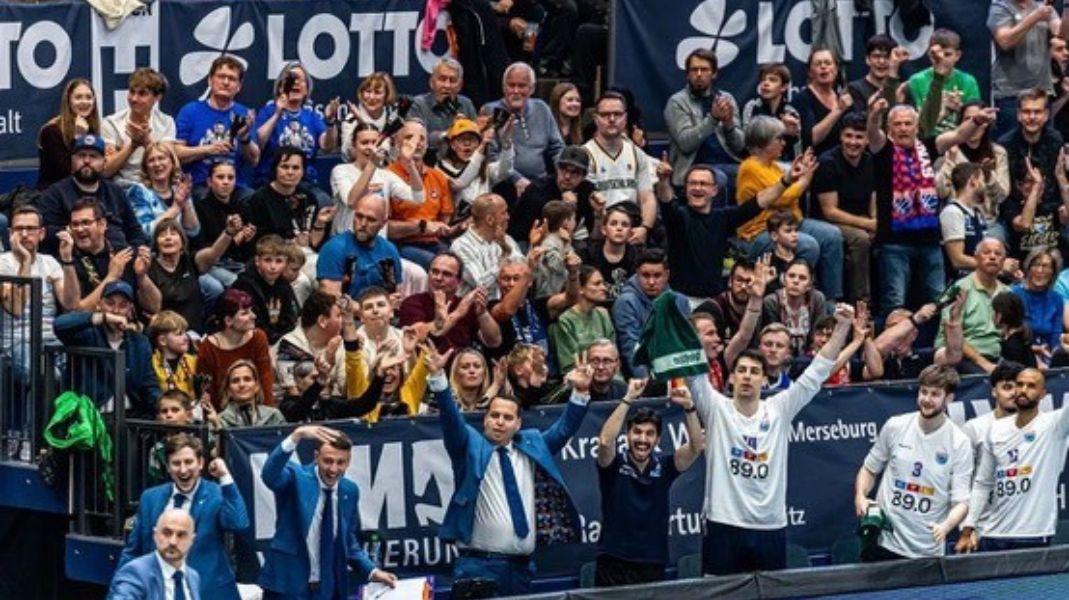
Simone Controne is Strength and Conditioning Coach at Syntainics MBC, a professional basketball team competing in Germany’s Basketball Bundesliga.
In this user story, Simone discusses some of the challenges of modern basketball schedules, with its high number of games and demanding travel schedules, and explains how Firstbeat data helps to keep players performing while minimizing injuries.

The Challenges of a Busy Season
The reality for many teams during the season is that when games are scheduled every two to three days, combined with travel time, it leaves very little time for practices.
For coaches and performance staff, success is not about training harder, but balancing performance, recovery, and player availability across congested competition schedules.
Simone recalls, “This year we had 48 official games, plus another 8 preseason games. Preseason is where we build the foundations of player programming, so I count those eight games in my work, even if officially they’re not counted. In the end, we played close to 60 games, so the work we did using Firstbeat definitely paid off because we had an extremely low number of injuries.”
Because of the congested schedule, it was important for Simone to consider how many minutes players could play consistently during each game.
Simone explains, “If you bring a player on for an average of 32 minutes, that’s already a lot. Not because the 32 minutes themselves are excessive, especially considering that any breaks in this total must be taken into account, but because your ability to properly prepare him before and after games becomes extremely limited.”
For multiple reasons, including player availability, the possibility of up to four games a week, and very limited training time, Simone adapted the team’s approach by standardizing strength work on game days, concentrating the highest load on that day while dedicating the following day to recovery.
Building a “Train As You Play” Philosophy
With limited practice time available during the season, Simone needed a way to ensure training still reflected the physical demands players would experience during games.
Simone says, “In the past, when teams only played once per week, you could do three full strength sessions weekly and keep players on the court for 40 minutes. Today, with these calendars, clubs simply can’t afford to have five players above 32 minutes consistently.”
Using Firstbeat data, he began structuring practices based on the physiological demands of competition. Simone says:
“During the year, the gold standard for me was always TRIMP, because very simply, it showed me the internal effort, the internal load that the players were producing.”
Rather than looking only at minutes played, Simone focused on understanding the true internal load experienced by each player and began monitoring both training and matches.
“I wanted complete datasets.” Simone explains, “eventually we managed to use Firstbeat in every training session, every game, every morning shootaround, not only to monitor training load but also to see if there were physiological alterations before games, like abnormal heart rates or recovery patterns.”
Over time, Simone started identifying how different drills consistently produced different physiological responses. This allowed him to structure training sessions almost like assembling building blocks.
“I started thinking of drills like Lego pieces,” he says. “I knew a certain type of 5-on-5 drill would produce a certain TRIMP value, while another type of drill would create a much higher intensity.”
By understanding these patterns, Simone could build sessions that matched the expected demands of upcoming games.
“There were moments where I needed more intensity, so we increased the pace or reduced stoppages. Other times I saw that a player was not recovering well and therefore we reduced the load immediately.”
Monitoring as a Piece of a Larger Puzzle
While Firstbeat provided objective data to support decision-making, Simone emphasizes that monitoring was never used in isolation.
Instead, the data became one part of a much broader performance process involving training, games, recovery and communication with the players and other coaching staff.
“Fortunately our coaches trusted me,” Simone explains. “Most of the time they did not even want the raw numbers, they wanted interpretation. They asked me: ‘What should we do today?’”
This allowed Simone to translate the physiological data into practical coaching decisions.
“If I told them that a player was overloaded after taking a knee impact, they trusted me when I recommended keeping him out of contact drills and reactivating him the following day.”
The ability to combine objective monitoring with coaching experience became one of the most valuable aspects of the process.
“The important thing is that Firstbeat gave objective evidence,” Simone says. “Without the data, many decisions would have remained simple guesses.”
At the same time, Simone stresses that data alone should never replace communication with players or coaching intuition.
“I never became dependent on the numbers,” he explains. “I always say: I love these numbers, but I do not depend on them.”
There were still moments where context mattered more than metrics alone.
“There were situations where the data suggested that a player should come off the court, but then the player looked at me and said: ‘I feel great, let me play.’ In those moments the data becomes secondary.”
Over time, Simone also found value in using metrics such as Movement Efficiency to help identify subtle warning signs before they developed into larger problems.
“Movement Efficiency became very useful to identify hidden problems, fatigue, compensations, inflammation, changes in movement quality,” he explains. “It is almost like detective work: finding clues inside the data.”
For Simone, this combination of monitoring, communication, and coaching judgment became essential to managing players throughout a demanding season. This strategy helped lead to the team achieving a bronze medal in the ENBL (European Cup) and maintaining their spot in the BBL.
See how top-performing basketball teams train smarter! Download our free Firstbeat Training Load Guide for Basketball Coaches.
If you liked this article, you should subscribe to our newsletter.
You might also be interested in

Managing Load After Off Days and Sickness – Expert Insights from Pro Basketball
This article is written by Domenik Theodorou, a Firstbeat Sports client and Performance Coach at RASTA Vechta, a professional basketball team competing in the Basketball Bundesliga (BBL) and FIBA Basketball…

Domenik TheodorouPerformance Coach, RASTA Vechta

Why Heart Rate Zones Are Not Enough in Team Sports
Heart rate monitoring has long been a valuable tool for understanding training load. Traditionally, heart rate zones have been used to describe intensity and guide training prescription. While this approach…
From Data to Court – Using Firstbeat in Women’s Basketball to Optimize Training and Recovery
In the world of competitive sports, every advantage counts. For women athletes, whose training needs and recovery patterns often differ from their male counterparts, understanding the intricacies of internal load…